The Elements of Effective Teaching framework outlines five intertwined elements of instructional practice that complement and enhance one another. When integrated into learning experiences, these elements foster student date with the ultimate goal of improving student outcomes and achievement. The framework is grounded in the agreement that students are more interested and invested in their learning when they feel condom in their learning environs, empathize what they are learning and why it matters, take opportunities to do, receive clear feedback on their work, and engage in complex, meaningful thinking.
The tool below supports educators to design and facilitate learning experiences that reverberate the v elements of constructive instruction and incorporate the corresponding key traits. While applying the key traits is critical, a demonstrated commitment to each element'south supporting beliefs is a necessary foundation for fostering student ownership of learning and ensuring equitable outcomes for all students.
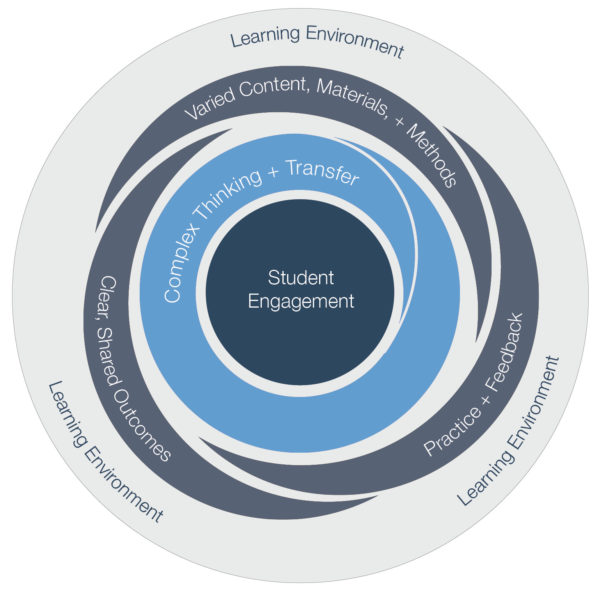
The learning environment supports all students to take risks, ask questions, and make and learn from mistakes. The physical space, routines and procedures, and development of positive relationships create a physically, socially, and emotionally safe environment.
Physical Space and Routines
Relationships and Civilization
The learning outcomes are shared and internalized past teachers and students. These outcomes anchor and guide the choices of instructional activities, materials, practice assignments, and assessment tasks. Outcomes are understood and used by students to set goals, guide learning, and prompt self-reflection.
- Learning outcomes are clear—both long-term (e.grand., graduation standards and operation indicators) and short-term (e.k., learning targets).
- Articulate descriptions of what success looks similar are established and shared.
- Materials, activities, and assessment tasks are selected by teachers and students to align with the learning outcomes.
- Students can explain how tasks and experiences align to learning outcomes.
- Students use standards and learning targets to reflect on their own progress and set goals for growth.
Varied Content, Materials, & Methods of Instruction
Students explore ideas and information in varied ways and admission learning through multiple entry points. Teachers select content and materials to engage and see the needs of all learners.
- Instructional materials and activities reverberate the identities of learners in the community and the diverseness of our earth.
- Content is selected and explored in ways that foster and reflect an understanding of multiple perspectives and critical issues.
- Teachers select materials for instructional activities to meet the needs of a diverseness of learners.
- Students take option in materials and topics in lodge to run into learning outcomes.
- Students brand meaningful choices virtually their learning and are taught how to make those choices well.
- Students learn new data in unlike ways–research, investigation, presentation, etc.
- Student groupings are flexible, varied and intentionally matched to the activity and learner.
- Students use a range of methods (differentiated homework, reading, activities) and supports (including applied science) to advance their learning.
- Time and structures support reteaching and extension of learning, every bit needed.
- Resources and materials ameliorate accessibility for a diversity of learners.
- Students take choices about how they demonstrate their learning.
- Students utilize multiple and varied pathways to reach common ends.
- Students use varied tools and supports (including engineering) to demonstrate learning.
- Assessments are relevant, authentic, and purposeful.
Students have opportunities to practice what they are learning and are given timely, specific feedback based on their current performance in relation to the desired outcomes.
- Routines, strategies, and pedagogy support pupil learning of essential skills and noesis by providing opportunities for practice.
- Opportunities for exercise let students to work independently, cooperatively, and with instructor guidance.
- Students practise applying complex skills over time within and across disciplines.
- Teachers requite students feedback that is timely, specific, and actionable.
- Students are taught how to give, interpret, and utilize feedback in their learning.
- Students have opportunities to give, receive, and use feedback to revise essential pieces of work.
Complex Thinking & Transfer
Students are coached and taught to engage in college guild thinking through instructional activities and practise tasks. Curriculum, instruction and assessments are designed to prompt circuitous thinking, integration of concepts and ideas, and application of learned skills to new material or novel situations.
Interested In Learning More than? Let's Talk.
Personalized, equitable, and student-centered teaching is as well of import to put bated. Together, we tin can improve learning for all your students.
Contact Us
carterfrood1966.blogspot.com
Source: https://www.greatschoolspartnership.org/resources/elements-of-effective-instruction/
0 Response to "According to Our Text, What Is One of the Most Important Ingredients of Effective Instruction?"
Post a Comment